
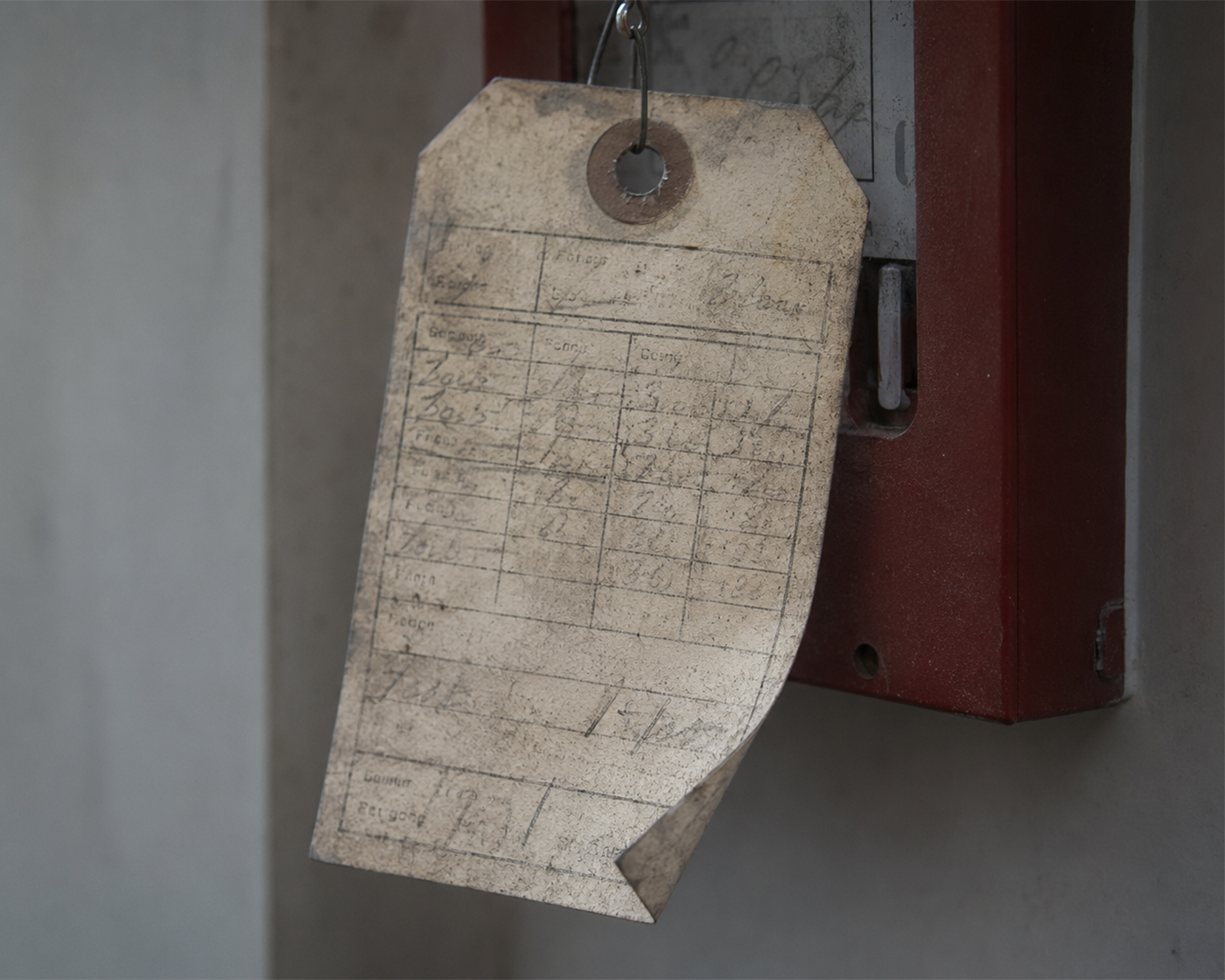
A worn red fire extinguisher on its wall bracket beside a pull station, a paper inspection tag hanging from the neck

Every unit you service is on a clock.
The spreadsheet does not know that.

A 6-month extinguisher service that slipped in March stays slipped. Nothing goes red, nobody gets told, and you find out when the client asks for the certificate.

Built in Trinidad and Tobago, for fire and life safety servicing firms. No card, no install, no sales call.

A neglected fire extinguisher with a grimy, half-illegible paper inspection tag

The problem

You already know which one it is.

  • The register is a spreadsheet, and one person understands the tabs.
  • A hood suppression system was serviced in May. The technician told somebody. It never reached the sheet.
  • A client asks for proof of the last inspection on a panel you know you did. Finding it takes a morning.
  • The 12-year hydrostatic test on a cylinder is the one nobody is watching. It is also the one that fails an inspection.
  • Every reminder in the business runs on somebody remembering.

None of that is a discipline problem. A spreadsheet has no way to warn anyone. It holds the last date you typed into it and then it sits there. That is the whole of it.

is a deadline engine.

It holds every unit you service, every cycle that unit carries, and the separate clock each of those cycles runs on. Then it tells you what is coming due, across every client, before it lapses.

This is a demo. The details fill in automatically so you can see the shape of it in two clicks. Nothing you do here is saved anywhere, and none of these clients, units or prices are real. In the live product you enter your own. Refresh the page and it goes back to the start.

This is the full working screen, and it is best explored on a laptop or desktop. On a phone you will get the idea, but there is more to take in with room to see it.

ember / Dashboard

Sunday 2 August 2026

Good morning, Kern

Needs repair 2

Non-compliant right now. Not a bookable job until it passes again, and not counted in the figure below.

Units that failed their last service
State Item and what the tech said Client Job value
Repair required Non-compliant right now EXT-2211 - 6-month technician service Extinguisher, CO2 5 lb|Main switch room Failed the 6-month service. Gauge reads discharged, no pressure. Replacement quoted. Bacolet Bay Hotel failed 21 Jul 2026 TT$450.00not in the due total
Repair required Non-compliant right now EL-118 - Annual 90-minute duration test Emergency light, twin spot|Stair core, level 2 Failed the 90-minute duration test. Battery held 22 minutes. Battery on order. Scarborough Health Complex failed 09 Jul 2026 TT$220.00not in the due total
What's due 6 jobs

Across all 3 clients, most urgent first, TT$5,975.00 of work, 1 with no price set.

Service cycles that are past due or due soon
Status Item & cycle Client Due Job value Action
Overdue EXT-4417 - 6-month technician service Portable extinguisher, ABC dry chemical 10 lb|Kitchen corridor, ground floor Bacolet Bay Hotel Denise Alleyne, 868-639-2214 14 Jun 202649 days overdue TT$450.00
Overdue HOOD-07 - Semiannual service Kitchen hood suppression, wet chemical|Main kitchen, cook line Milford Road Plaza Rawle Boodoo, 868-635-1180 09 Jul 202624 days overdue TT$1,850.00
Overdue FACP-02 - Annual functional test Fire alarm control panel, 8 zone|Security office Canaan Industrial Park Sherwin Grant, 868-631-4407 22 Jul 202611 days overdue TT$2,400.00
Due soon HR-31 - Annual physical inspection Fire hose reel, 30 m|Dive shop wall Speyside Dive Lodge Marlon Job, 868-660-5192 11 Aug 2026in 9 days TT$375.00
Due soon SPR-01 - Quarterly waterflow alarm test Sprinkler system, wet, riser 1|Plant room, basement Scarborough Health Complex Anisa Mohammed, 868-639-8130 19 Aug 2026in 17 days TT$900.00
Due soon EXT-1180 - 5-year hydrostatic test Portable extinguisher, CO2 10 lb|Loading bay Canaan Industrial Park Sherwin Grant, 868-631-4407 02 Sep 2026in 31 days no price set

One row per service cycle, not per unit. A unit with four cycles can appear four times, and should. Blank is not zero: the unpriced cycle above is left out of the total rather than counted as zero.

What we track

Thirty types of equipment, in six families.

Every one of them arrives carrying its own set of cycles, each on its own clock, at a researched interval you confirm before it counts.

The built-in library ships 30 equipment types, drawn from 24 researched entries. The two numbers differ for one reason: portable extinguishers are split one type per agent, because the hydrostatic interval is not the same for dry chemical as it is for CO2 or water. Seven agents plus the other twenty-three entries is thirty. That is the whole list, and it is below.

Those thirty are the built-in library, and they are where a firm starts, not where it stops. You can author your own equipment types and your own categories beside them. A type you wrote is marked as yours, so nobody a year later mistakes an interval you chose for one that arrived with the library.

How it works

How logging a service works.

Six fields, in this order. The first one is the one that makes this different from a spreadsheet.

  1. 1 Choose the service cycle

    Which cycle

    A unit does not have "a" service. One extinguisher carries a six-month technician service, a six-year internal examination and a twelve-year hydrostatic test, each on its own clock. You say which one you just did. The others keep their own dates.

  2. 2 Date serviced

    Date serviced

    The day you actually attended, not the day it was scheduled for. Everything after this counts from the date you enter here.

  3. 3 Service outcome

    Outcome

    Two buttons. Passed, in service. Or Failed, needs repair or replacement. There is no third answer and no free-text status to interpret later.

  4. 4 Service notes

    Notes

    What you found, in your words. Recharged, seal replaced, gauge in the green. On a failure, what is wrong with it and what it needs. It can be left empty.

  5. 5 Tag photo

    Tag photo, optional

    Photographing the dated tag proves the visit happened, and on a failure it justifies the repair charge. It is never required. It attaches to the entry after the entry is saved, and you can add it later, so a basement with no signal cannot stop you recording work you have already done.

  6. 6 Save the service

    Save service

    The entry is permanent. The date and the result can never be edited afterwards; only the note and the photo. That is what makes the history worth showing anyone.

Then one of two things happens, and only one of them is a date.

Passed

The cycle re-clocks. The next occurrence is counted forward from the date you entered, and the unit drops off the due list until that date comes round. Its other cycles are untouched.

Failed

No next date is generated. The cycle holds where it is and the unit moves into the repair panel, leaving the due list entirely, because a non-compliant item is not a bookable job. Its other cycles keep their own clocks.

Front of house

What it takes off your week.

The reminder goes out before the date, not after.

An email lands while there is still time to put the visit in the diary. Nothing fires on a date nobody has confirmed, so what does arrive is worth reading.

A reminder sent before the service date

Logging a service takes seconds.

Pick the unit, pick the cycle, pass or fail, save. The next date is computed from the interval. Nobody types a date twice and nobody carries one home in their head.

Logging a completed service in seconds

The register stays current because working it keeps it current.

The list of units is the same list the technician services from. There is no second copy to reconcile on a Friday.

An equipment register kept current

Being built now

A record an insurer will accept.

A printable client history: every visit, unit by unit, with the cycle, the interval it runs on, the date, the technician and the result. The dated proof a spreadsheet has never been able to hand anyone. It is being built now, and founding firms shape it.

A printable client service history

Back of house

What you never have to think about.

The data is yours.

Your clients, your register and your history belong to you, not to us. You are not locked in, and nothing is held in a format only ember can read. A full export you can hand to anything else is being built now.

Your data belongs to you

History cannot be quietly rewritten.

A logged service keeps its date, its result and its price. A correction is recorded as a correction, with the original still readable underneath it, so the record shows what happened and what was fixed.

A tamper-evident service history

Founding firms

We are taking a small number of firms first.

ember is built in Trinidad, for the way fire and life safety firms here actually work: the intervals you already work to, the currency you quote in, the register you already keep. It is opening this quarter, and it is not open to everyone yet.

The founding firms

The waitlist is the founding firm programme, not a mailing list. The first firms in help shape the ember they will run their business on.

  • First access

    You are in before ember opens to everyone else.

  • A say in what gets built

    Requests and problems from founding firms go to the front of the queue while ember is being finished.

  • A founding rate, locked in

    When pricing is announced, founding firms keep their rate. Later increases do not reach you.

  • The person who built it

    Direct access to the person who built ember, not a support queue.

It takes about a minute. We ask what you service and how many clients, and nothing else. Someone will come back to you when there is a seat.